Springer Nature Proceedings Computer Science
Testbeds and Research Infrastructure: Development of Networks and Communities
Chronologie aller Bände (1 - 2)

Die Reihenfolge beginnt mit dem eBook "Testbeds and Research Infrastructure: Development of Networks and Communities". Wer alle eBookz der Reihe nach lesen möchte, sollte mit diesem Band von Thanasis Korakis beginnen. Die Reihe umfasst derzeit 2 Bände. Der neueste Band trägt den Titel "E-Voting and Identity".
- Anzahl der Bewertungen für die gesamte Reihe: 0
- Ø Bewertung der Reihe: 0
Diese Reihenfolge enthält 2 unterschiedliche Autoren.
- Band: 44
- Autor: Korakis, Thanasis
- Anzahl Bewertungen: 0
- Ø Bewertung:
- Medium: E-Book
- Veröffentlicht: 28.11.2012
- Genre: Comedy
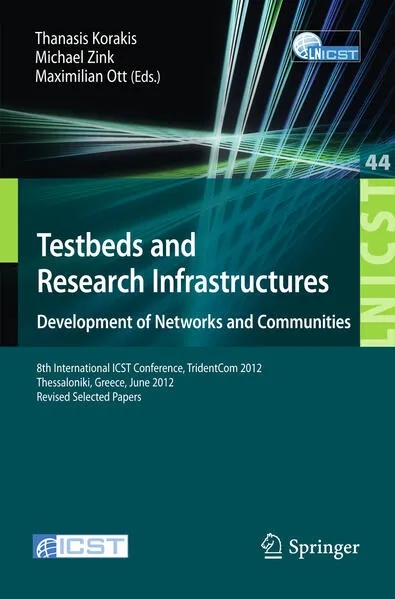
Testbeds and Research Infrastructure: Development of Networks and Communities
This book constitutes the proceedings of the 8th International ICST Conference, TridentCom 2012, held in Thessanoliki, Greece, in June 2012. Out of numerous submissions the Program Committee finally selected 51 full papers. These papers cover topics such as future Internet testbeds, wireless testbeds, federated and large scale testbeds, network and resource virtualization, overlay network testbeds, management provisioning and tools for networking research, and experimentally driven research and user experience evaluation.

- Band: 7985
- Autor: Heather, James
- Anzahl Bewertungen: 0
- Ø Bewertung:
- Medium: E-Book
- Veröffentlicht: 08.07.2013
- Genre: Comedy
E-Voting and Identity
This book constitutes the thoroughly refereed conference proceedings of the 4th International Conference on E-Voting and Identity, Vote ID 2013, held in Guildford, UK, during July 17-19, 2013. The 12 revised full papers presented were carefully selected from 26 submissions. The papers include a range of works on end-to-end verifiable election systems, verifiably correct complex tallying algorithms, human perceptions of verifiability, formal models of verifiability and, of course, attacks on systems formerly advertised as verifiable.